
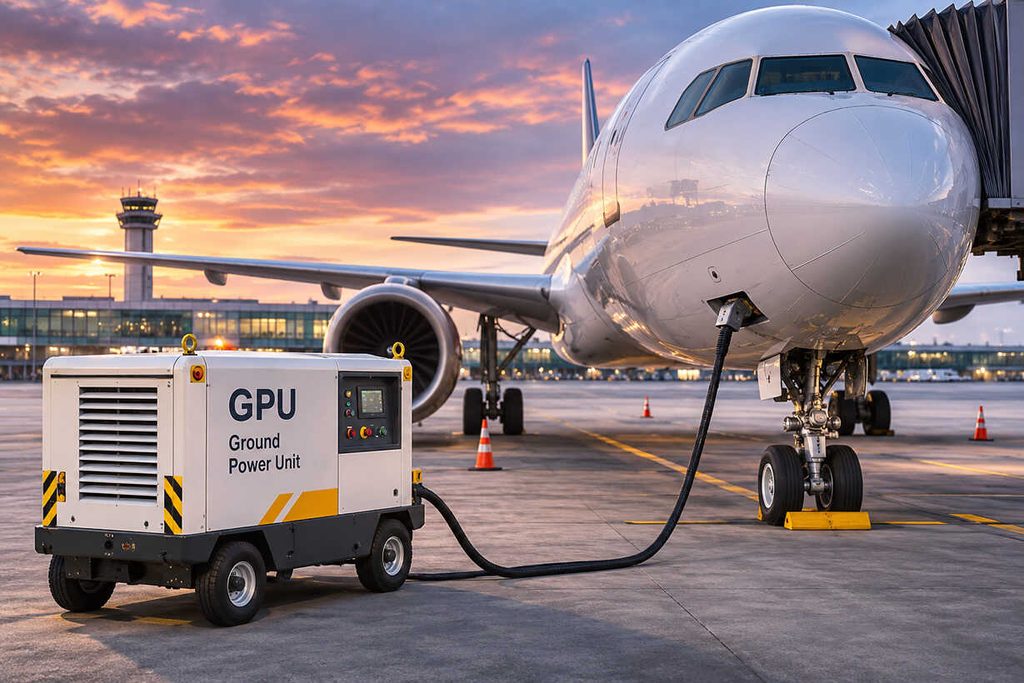
Walk across an airport apron and you’ll see baggage tugs, fuel trucks, catering lorries and stairs. Easy to miss among them is a humbler piece of equipment: a boxy unit on wheels, or a cable hanging from the terminal building, plugged into the belly or nose of an aircraft. This is the Ground Power Unit, or GPU. It supplies electricity to a parked aircraft so that the aircraft can keep its lights on, its systems running and its cabin comfortable without burning its own aviation fuel. It is rarely noticed, but modern aviation would be noisier, dirtier, more expensive and less reliable without it.
What is a Ground Power Unit?
A Ground Power Unit is a device that provides electrical power to an aircraft while it is on the ground and its engines are shut down. Depending on the design, it may also provide compressed air or conditioned air, though the electrical function is the defining one.
Aircraft don’t run on household electricity. Most commercial aircraft use three-phase alternating current at 115/200 volts and a frequency of 400 hertz, a higher frequency than the 50 or 60 hertz of mains grids. The higher frequency allows lighter transformers and motors, which matters when every kilogram on an aircraft counts. Many military and smaller aircraft use 28-volt direct current, and some use both. Ground Power Units therefore have to convert the power they draw or generate into exactly the form the aircraft expects, delivered through standardised connectors.
GPUs come in several forms:
- Mobile diesel GPUs. A diesel engine drives a generator, all mounted on a trailer or self-propelled chassis. These are the traditional units and can be taken wherever they are needed, including remote stands and airfields without fixed infrastructure.
- Fixed ground power. At many modern terminals, power is supplied from the building itself. A static converter takes mains electricity and transforms it to 400 Hz. The output runs through a cable mounted on the passenger boarding bridge or in a pit in the apron surface.
- Battery-electric and hybrid mobile units. These carry large battery packs, sometimes paired with a small engine to extend range. They produce no local emissions and very little noise.
- Military and specialist units. These are built for rugged field use, often supplying 28 V DC for starting engines and powering avionics, and are sometimes combined with air-start or hydraulic test capability.
Also Read: Gunnr Launches New Scopes to Lead the Market with Superior Performance
A Brief History
In the early decades of flight, aircraft barely needed ground power. Electrical systems were minimal, often just ignition magnetos, a few lights and later a radio. Engines were started by swinging the propeller by hand.
As aircraft grew larger and more complex through the 1930s and 1940s, the electrical load grew with them. Radios, navigation aids, gun turrets, heating and instrumentation all demanded power, and big piston engines were increasingly hard to start by hand. Ground crews began to use wheeled battery carts and small engine-driven generators, such as the trolley accumulators familiar to Second World War air forces. These let crews start engines and check systems without draining the aircraft’s own batteries, which were heavy and precious.
The jet age made ground power essential. Early turbojets and turbofans needed a burst of power or air to start, and airliners had to keep systems alive during turnarounds. Airlines and air forces built up fleets of mobile generators, often noisy diesel units pulled up beside the aircraft and left rumbling.
The auxiliary power unit (APU) emerged in this period. An APU is a small turbine engine, usually in the tail of the aircraft, that can generate electricity and supply compressed air for engine starting and air conditioning. Some jetliners of the early 1960s, such as the Boeing 727, were designed so they could operate from airports with little ground support equipment. The APU gave airlines flexibility, but it also gave them a new habit: running a small jet engine at the gate for long periods.
From the 1980s onward, airports increasingly invested in fixed electrical ground power and pre-conditioned air at the gate. The motive was partly cost and efficiency, but increasingly it was environmental. Noise rules, local air-quality targets and carbon-reduction commitments pushed many airports to restrict APU use and encourage or require connection to ground power. More recently, battery-electric GPUs and smart, networked systems have begun to replace older diesel units.
Why Ground Power is Used
Even with engines off, a parked aircraft has real electrical needs, and several things happen during a turnaround that depend on power:
- Cabin systems. Lighting, galley equipment, in-flight entertainment systems and cabin air circulation all need electricity while passengers board, disembark and are cleaned up after.
- Cockpit and avionics. Pilots power up flight management computers, navigation systems and displays, and run pre-flight checks and programming before departure.
- Maintenance and testing. Engineers need power to run diagnostics, test systems, and carry out work on electrical, hydraulic and avionic components without starting engines.
- Engine starting. Electric starter-generators and some starting systems draw on ground power, and military aircraft commonly rely on external 28 V DC to start.
- Cargo and servicing. Cargo loading systems, galley servicing and other ground operations often require aircraft power to be on.
Without ground power, the aircraft would have to supply all of this itself, either from its batteries, which would drain within a short time, or from the APU or engines.
Also Read: Ideagen Expands Safety Solutions with Reactec Acquisition
Why Ground Power is Important
Fuel savings and lower costs. Burning jet fuel in an APU to power an aircraft that is simply sitting at a gate is inefficient. An APU on a typical narrow-body airliner can burn on the order of a hundred kilograms of fuel an hour or more. Electricity from a fixed ground connection is far cheaper per hour of use. Across a large airline’s thousands of turnarounds, the savings are substantial.
Reduced emissions. Every kilogram of fuel burned releases carbon dioxide, along with nitrogen oxides, particulates and other pollutants. Replacing APU running with grid electricity, particularly where the grid is increasingly low-carbon, reduces both greenhouse gas emissions and the local pollution that affects airport workers and nearby communities.
Noise reduction. An APU is loud. Ground crews working beside the aircraft are exposed to its noise for hours at a time, and airports in built-up areas face complaints from neighbours. Fixed electrical power and battery GPUs are far quieter, which makes the apron a better place to work.
Engine and APU life. Running an APU wears it out, and APU maintenance is expensive. Using ground power reduces APU running hours and extends the intervals between overhauls. Because the APU is also a critical backup in flight, preserving its reliability has safety value.
Safety. A stable, standardised external power source gives crews and engineers a predictable way to power aircraft during maintenance and servicing, without relying on engines running near people and equipment. Keeping engines and APUs off near fuelling and boarding operations also reduces risk to those working around the aircraft.
Operational reliability. Ground power lets an aircraft be prepared, serviced and tested on schedule, and it provides redundancy: if an APU fails, the aircraft can still be turned around using ground equipment. For military operations, reliable external power is part of keeping aircraft available and ready to launch quickly.
What Would We Do Without Them?
Imagine a world without aircraft GPUs. Aviation would carry on, because aircraft can and do operate without them, but it would look and feel different.
First, every aircraft would rely on its own APU or engines on the ground. Gates would be filled with the whine of turbines and the smell of exhaust, and airport air quality would be noticeably worse. Fuel burn and operating costs would climb, and airlines would pass at least some of that cost on to passengers.
Second, maintenance would become harder. Engineers who need to power systems for troubleshooting would need engines or APUs running, which means more risk, more noise and more restrictions. Some tasks would be slower or have to be done in different ways.
Third, remote and austere operations would suffer. Military air forces, air ambulances, bush operators and disaster-relief flights often depend on portable power to start and service aircraft away from a main base. Without it, more aircraft would need heavy onboard starting systems, and operating from basic strips would be more difficult.
Fourth, aircraft design itself would change. Designers might need larger batteries or more capable onboard generation, adding weight and cost to every aircraft, which would in turn burn more fuel in flight. The ground power ecosystem lets aircraft stay lighter by leaving some capability on the ground.
Finally, environmental targets would be harder to reach. Many airports’ climate and air-quality plans depend on cutting APU use. Without ground power, there would be no practical way to do so, and the aviation industry’s ground-based emissions would be higher.
The Future of Ground Power
The GPU is evolving along with the rest of aviation. Airports are rolling out more fixed electrical ground power and pre-conditioned air at gates and remote stands, and some are mandating its use. Battery-electric mobile units are replacing diesel ones, and smart systems can monitor connection, load and energy use. As electric and hybrid-electric aircraft arrive, ground charging infrastructure will build on the same ideas, and the airport apron may increasingly resemble a high-capacity electrical network. Hydrogen and other new energy carriers may also bring their own ground-support requirements.
Also Read: The Importance of the Alternator in Tractor Energy Efficiency
Conclusion
Ground Power Units are the kind of technology that succeeds by being invisible. They have grown from simple battery carts and generators into a sophisticated part of airport infrastructure. By keeping aircraft powered without burning fuel in the air or on the ramp, they save money, reduce emissions and noise, protect equipment, and keep the daily rhythm of aviation running. Remove them and aviation would still fly, but it would be louder, dirtier, costlier and harder to maintain. They are one of those quiet pieces of engineering that the whole system rests on.