
Moving from testing artificial intelligence to using it in a real business environment often reveals a major gap. While building a local AI agent on a personal computer is fairly simple, running that same system securely on public servers requires strict oversight. Industry data highlights a concerning difference in how these systems are currently managed. Although 79% of businesses are currently running AI agents in production, only 2% utilize identity security tools built specifically for them.
This lack of preparation presents a severe risk. Industry analysts like Gartner have warned that over 40% of enterprise AI agent projects will face cancellation by 2027 due to weak risk controls and massive cost overruns. The main issue is that businesses often overlook the heavy maintenance required to keep autonomous systems safe. Running an agent involves three real costs: the server infrastructure, the language model API, and the engineering time spent on maintenance.
To solve these exact operational hurdles, the industry is shifting toward specialized, managed infrastructure.
Cloudways Managed AI Agents offers an isolated environment, automated backups, managed security patching, and SSH access. This evolution allows businesses to focus on the actual output of their autonomous tools rather than the server maintenance required to keep them online.
The Hidden Operational Costs of AI Agents
Understanding how an AI agent operates is essential to recognizing why it demands specialized hosting. Unlike standard chatbots that wait for a prompt, an AI agent operates on its own to achieve a specific goal. It accomplishes this through a continuous cycle known as the ReAct loop, which stands for Reasoning and Acting.
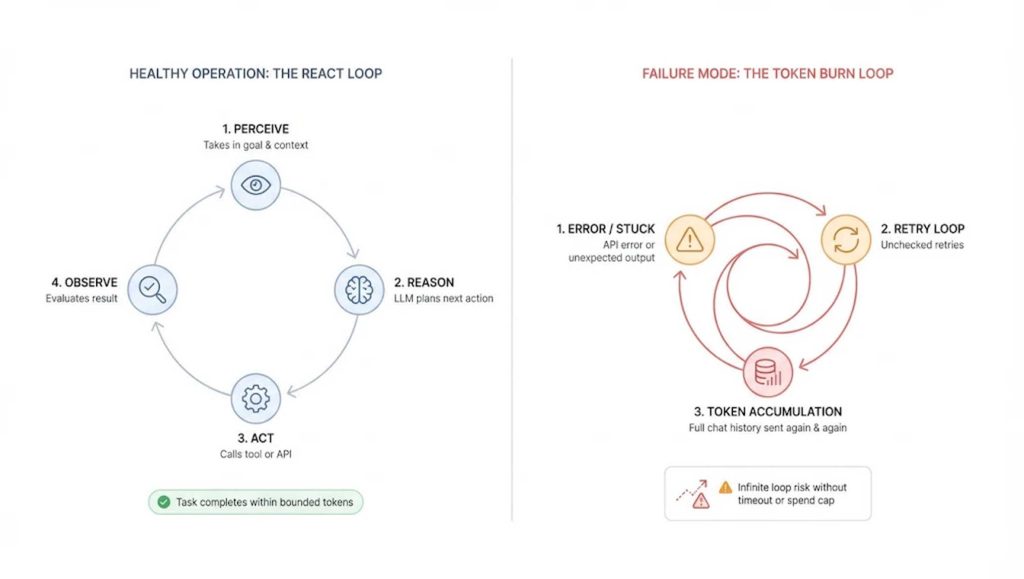
The agent perceives its current situation, reasons through the available options, takes a concrete action using an external tool, and then observes the result. This cycle repeats continuously until the assigned task is finished.
Because agents work around the clock, they require servers that run 24 hours a day without interruption. Deploying these systems on an unmanaged Virtual Private Server (VPS) initially appears cheap, but it introduces hidden expenses.
Also Read: UK AI Firm Launches New Product GATE to Close the AI Governance Gap Facing Regulated Businesses
Businesses must assign engineers to handle operating system updates, manage Docker environments, renew SSL certificates, and monitor for broken software. The financial impact of this maintenance time quickly surpasses the raw cost of the server itself.
Beyond maintenance hours, unmanaged agents present a severe financial risk known as token burn. When an autonomous agent encounters an error or gets stuck on a specific step, it does not simply shut down. It continues to try different approaches.
With every new attempt, the agent sends its entire accumulated conversation history back to the language model API. This means every loop becomes progressively more expensive than the last. In one documented incident, two agents repeatedly sent requests to each other for 11 days, resulting in a $47,000 API bill. In another case, a development team discovered a $4,200 charge generated overnight by a single stuck agent.
The Security Crisis: What Happens When Agents Are Left Unmanaged
Connecting an AI agent to business email accounts, calendar systems, and file storage gives it deep access to sensitive digital assets. If that agent is hosted on unmanaged servers with default settings, those assets become highly vulnerable.
The early 2026 security crisis surrounding the OpenClaw agent serves as a stark example of these dangers. In January 2026, security researchers discovered a critical vulnerability in the agent’s gateway, designated as CVE-2026-25253. Exploiting this flaw did not require any passwords or credentials. A bad actor only needed to send a single malicious link to the agent to execute unauthorized code on the host machine.
Because thousands of users deployed the software on unmanaged servers without proper monitoring, the damage was extensive. By February 2026, over 135,000 exposed instances were identified across 82 different countries.
Attackers uploaded over 800 malicious skills to the community hub, disguising them as standard integrations for Gmail, Notion, and GitHub. Any business that installed these compromised skills unknowingly allowed attackers to harvest passwords and browser cookies.
Incidents like this demonstrate why strict governance and boundaries are mandatory for production deployments. Businesses must implement “human-in-the-loop” protocols, treating approval gates as a design decision rather than a simple on-off switch. Low-risk tasks, such as reading emails or searching the web, can proceed autonomously.
High-risk actions, such as sending emails to clients or modifying production code, should require human authorization before execution. Furthermore, agents should only be granted access to the specific data and tools strictly necessary for their assigned tasks.
Choosing the Right Agent for Production Workflows
As autonomous systems transition into everyday business operations, operations leaders must decide which software best fits their business structure. Two open-source agents currently dominate the landscape: OpenClaw and Hermes.
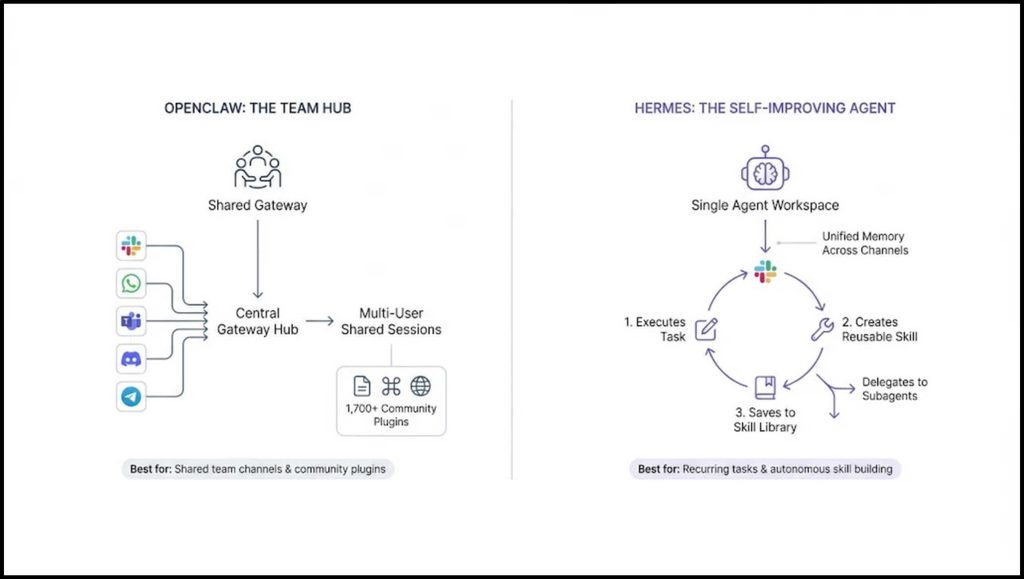
Both projects utilize an MIT license, meaning they are free to use without software licensing fees. Both systems also maintain state, allowing them to carry memory and learned skills over between sessions so they do not start from scratch every day.
Despite these similarities, the two systems are built with entirely different focuses.
OpenClaw: The Team Hub
OpenClaw functions as a central hub designed for team collaboration. It utilizes a single gateway that connects an agent to over 30 different messaging channels, including WhatsApp, Slack, Microsoft Teams, and Discord.
This structure allows multiple employees to share the same gateway, open joint sessions, and steer the agent’s work together. OpenClaw relies heavily on a community ecosystem, allowing businesses to extend the agent’s capabilities by installing any of the 1,700 available community-built skills and plugins.
Hermes: The Self-Improving Agent
Hermes, developed by Nous Research, takes a different approach by focusing on deep, self-improving personalization. Instead of acting as a shared team hub, Hermes serves as a single agent with a unified memory that follows a specific user or team across over 27 supported channels, including Signal and email.
Its primary strength is that it builds its own skills over time. Every time Hermes successfully completes a new task, it generates a reusable skill from that solution. The agent gets progressively better at its job the longer it runs, making it highly effective for recurring reports, background briefings, and routine administrative tasks.
It can also delegate complex jobs to isolated subagents, providing each with its own separate conversation thread and terminal.
Securing Deployments with Managed AI Agent Infrastructure
Running powerful, deeply connected agents on unmanaged servers places the entire burden of security and maintenance on the business. Moving to a managed infrastructure service removes these operational hazards.
Cloudways Managed AI Agents offers deployment for both OpenClaw and Hermes on isolated, secure infrastructure.
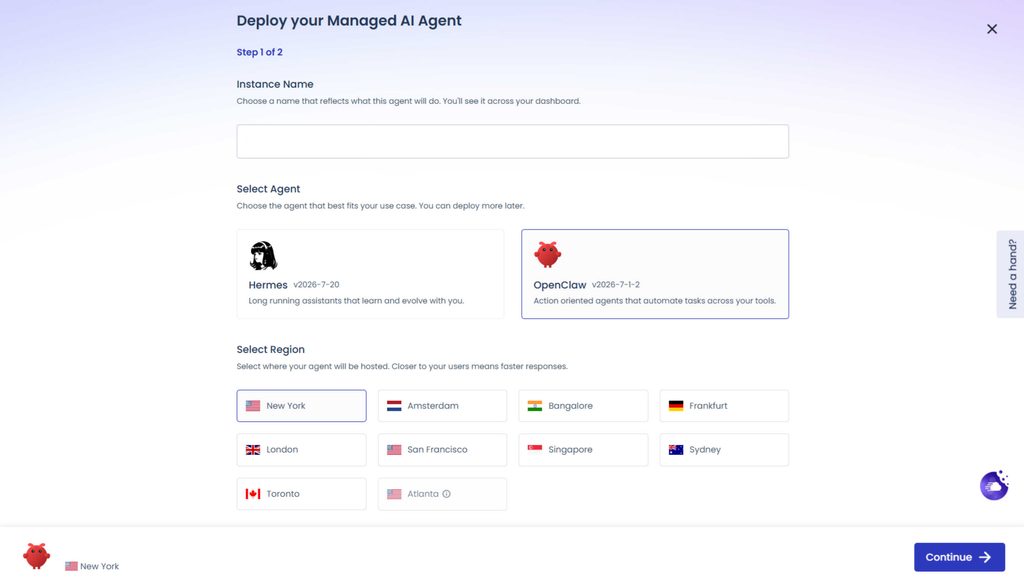
Every agent deployed through the platform runs on its own isolated instance. This complete separation ensures that an agent only interacts with the specific tools and data explicitly connected to it, preventing data from mixing with other users or systems.
To prevent the software vulnerabilities that caused the 2026 security crisis, the platform tests every new OpenClaw and Hermes release before rolling it out to active servers.
Also Read: OpenClaw vs Hermes: Choosing Between Multi-Agent Routing and a Self-Improving Agent
If a software update causes instability or breaks an agent’s learned skills, operators can roll the system back to its last working state in a matter of minutes. Routine server administration, including daily automated backups and SSL certificate management, runs silently in the background.
For development teams that require deeper control over the environment, secure terminal and SSH access remain fully available.
Managed hosting also preserves a business’s ability to control its own language model spending. Businesses connect their preferred AI provider using the Bring Your Own Key (BYOK) method or OAuth which allows for the use of the existing OpenAi subscription for LLM.
The platform interface natively supports API connections from OpenAI, Anthropic, Google, OpenRouter, and DigitalOcean, ensuring that usage costs remain directly with the chosen provider.
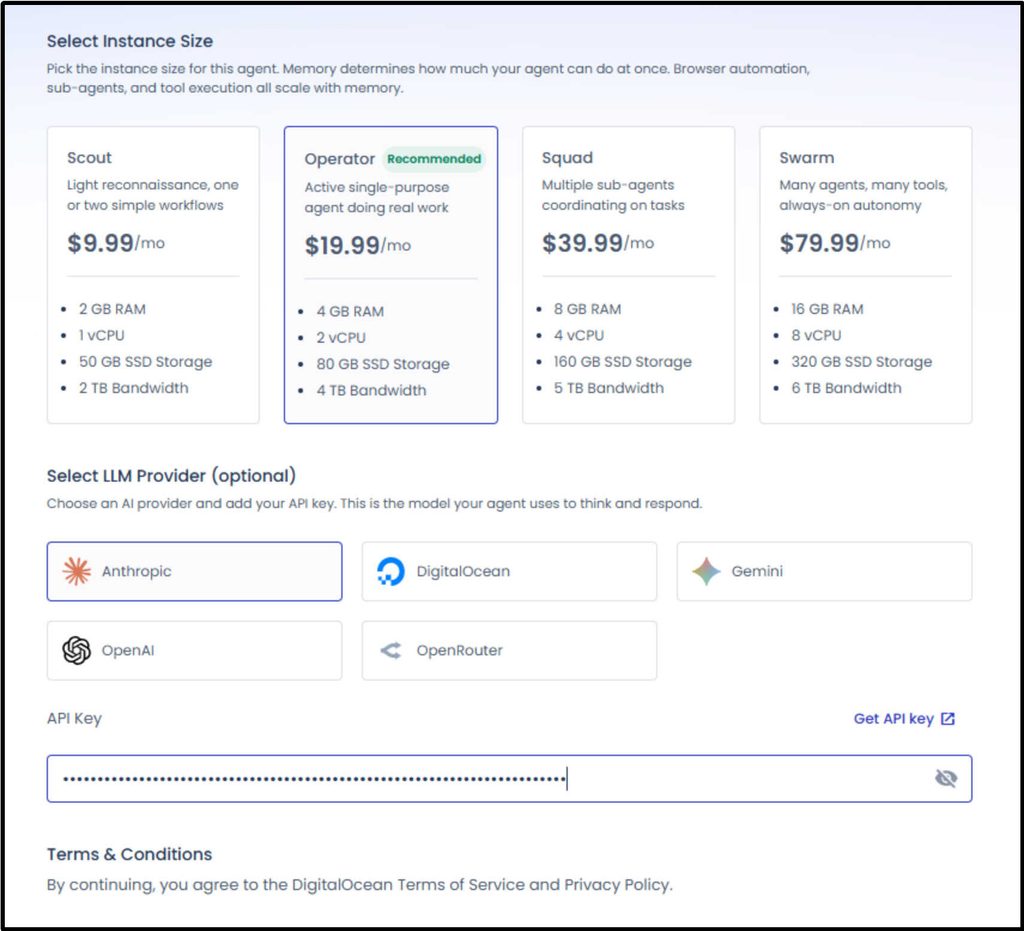
This flexibility allows businesses to route simple tasks to cost-effective models and reserve premium models for highly complex reasoning, keeping API bills predictable.
Wrapping Up
The success of an autonomous business tool relies entirely on the stability of the environment hosting it. Attempting to manage server setups, software patching, and security monitoring manually diverts valuable engineering time away from actual product development.
Utilizing managed infrastructure secures the deployment, prevents unauthorized access, and ensures the agent remains online continuously.
Businesses looking to integrate these systems can test their deployment readiness during the Cloudways Black Friday and Cyber Monday promotion, which offers 80% off for the first two months using the code BFCM802.
This provides a secure, cost-effective pathway to implementing fully functional, resilient AI agents before the next major surge in business demand.