
For businesses deploying Serverless and VPS Node.js hosting applications, finding the right infrastructure often forces a difficult choice between operational ease and financial control.
Development teams typically have to weigh the zero-maintenance appeal of serverless architecture against the predictable performance and flat billing of a traditional Virtual Private Server (VPS).
Finding a hosting solution that balances cost forecasting, fast response times, and minimal administrative overhead is critical for scaling applications successfully.
Choosing How to Host Your Node.js App
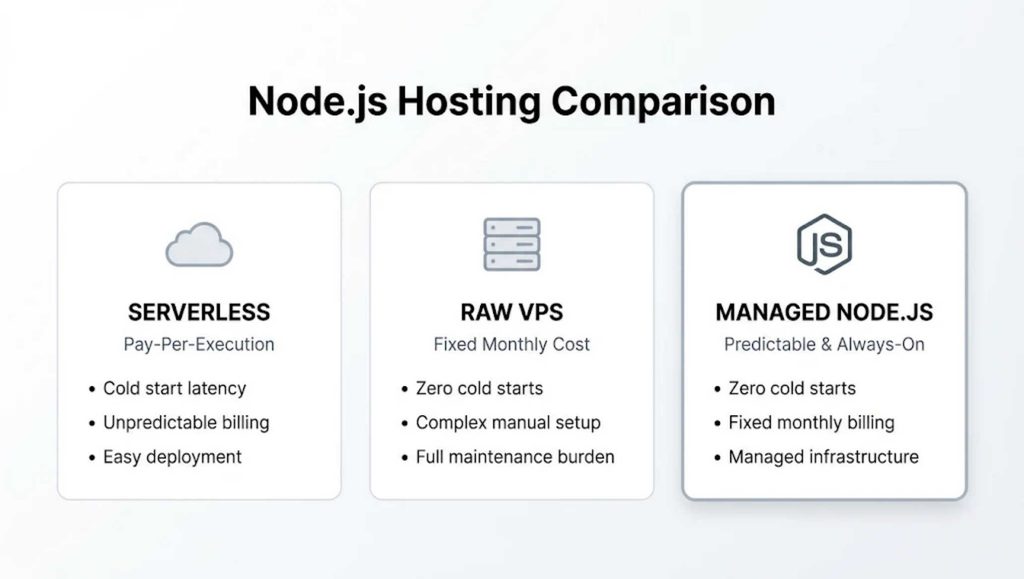
When deploying a Node.js application, businesses typically face a standard infrastructure choice. On one side is serverless hosting, which promises ease of use and zero server management.
On the other side is the traditional Virtual Private Server (VPS), which offers complete control over the environment.
Both of these extremes force a compromise. Technical teams are often left choosing between application performance, billing predictability, and the number of hours spent on maintenance.
Understanding these trade-offs is necessary to find a hosting solution that supports business growth without introducing technical debt or financial surprises.
The Problem With Serverless: Cold Starts and Unpredictable Bills
Many serverless platforms operate on an on-demand model. When an application receives traffic, the provider spins up a container to process the request. After a period of inactivity, some platforms scale those workloads down to zero to save resources. When the next user visits the site, the container may need to boot up from scratch This delay is known as a cold start, which can introduce noticeable latency.
Beyond potential performance trade-offs, serverless pricing can make budgeting harder. Because many serverless providers use pay-per-execution or usage-based billing, costs often scale directly with traffic. While this can be inexpensive during initial development, a sudden traffic spike, marketing campaign, or bot attack can lead to unexpected bills, making it difficult to forecast monthly infrastructure expenses.
Also Read: 5 Ways to Manage and Reduce Costs on the Azure Cloud
The Problem With a Raw VPS: Too Much Maintenance
Provisioning a raw Virtual Private Server solves the two main problems of serverless hosting. A VPS runs on persistent server resources, which avoids the scale-to-zero cold starts common on serverless platforms. It also operates on a fixed-rate billing model.
The business pays a predictable rate for a fixed allocation of server resources and bandwidth, making cost forecasting straightforward within those provisioned limits until you decide to scale up.
However, a raw VPS introduces a heavy maintenance burden. The business is responsible for all server management. Technical teams must manually configure the server environment, install runtime dependencies, and set up reverse proxies like Nginx to route traffic properly.
This setup also requires ongoing maintenance. The business must handle regular operating system security patches, manage SSL certificate renewals, and manually monitor application health. This operational overhead takes time away from actual product development and requires dedicated system administration expertise.
The Middle Ground: Managed Node.js Hosting
Businesses do not have to accept the latency of serverless platforms or the heavy maintenance requirements of a raw VPS. Managed Node.js hosting environments act as a middle ground. These platforms bridge the gap by combining the deployment ease of serverless with the performance stability of a traditional server.
In a managed setup, the application runs on persistent infrastructure resources rather than scaling to zero. This avoids typical serverless cold-start delays and helps maintain more consistent response times. Furthermore, managed hosts typically charge a fixed monthly rate for server resources.
This structure removes the risk of billing surprises and allows for accurate budget planning. Most importantly, the hosting provider handles the underlying infrastructure maintenance, including server configuration, OS-level security, and deployment tooling. While teams still manage their application code, dependencies, configuration, and resource planning, this setup significantly reduces the day-to-day sysadmin burden.
Key Features of a Managed Node.js Setup
When evaluating a managed Node.js hosting provider, businesses should look for specific features that streamline operations.
- Automated Deployments: A managed platform should connect directly to a Git repository. This allows developers to push code updates automatically without relying on manual file transfers or complex continuous integration pipelines.
- Built-in Platform Security: The provider should manage platform-level security, such as firewalls, OS-level security patches, and SSL certificates, while your team remains responsible for securing application code, dependencies, credentials, and configuration.
- Resource Monitoring: To maintain performance, teams need real-time visibility into server health. A proper managed host provides dashboards tracking CPU utilization and memory usage. This data allows the business to know exactly when it is time to scale up the server size as traffic grows.
How Cloudways Velocity Bridges the Gap
Cloudways Velocity is a managed Node.js hosting platform built specifically to eliminate the standard trade-offs between serverless and VPS environments. Instead of spinning idle containers down, Velocity uses an always-on architecture with persistent server resources that avoids platform cold starts.
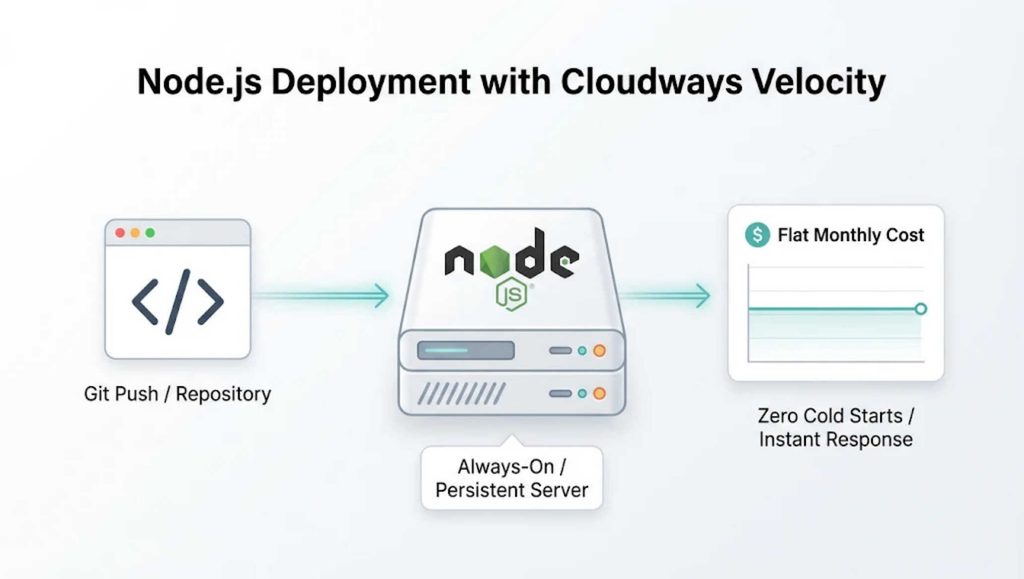
Financially, Velocity uses a pay-as-you-go pricing model, with servers billed hourly based on the selected plan rather than per-execution or traffic-based billing. This provides predictable hourly or monthly-equivalent pricing for your allocated CPU, RAM, and bandwidth. Traffic spikes do not automatically increase your hourly compute bill, though exceeding your plan’s resource capacity can affect performance until you scale up to a higher plan.
A single Velocity plan can also host multiple Node.js applications simultaneously. Because these applications share the plan’s allocated resources, teams should choose a plan based on their combined workload rather than assuming each app receives dedicated CPU and RAM.
The platform connects directly to GitHub, GitLab, or Bitbucket repositories for automated deployments, automatically detecting frameworks like Next.js, Express, and React.
Furthermore, Velocity reduces the manual DevOps burden by pre-configuring the NGINX and PM2 stack and handling platform-level security, including OS patching, a Web Application Firewall, and Cloudflare Enterprise CDN. Teams remain in control of securing their application code, dependencies, credentials, and configuration.
Also Read: First-Tier Support by AI is Changing What Managed Hosting Costs Growing Businesses
Wrapping Up
When deploying a Node.js application, businesses do not have to settle for the unpredictable costs and cold starts of a serverless architecture. They also do not need to take on the heavy technical maintenance required by a raw VPS.
A managed Node.js environment provides the required performance stability and cost control necessary for growing applications. By letting a provider handle routine server maintenance, teams can spend more time building their product.
For teams ready to secure predictable infrastructure costs, the Cloudways Black Friday and Cyber Monday promotion is currently active. Applying the promo code BFCM802 provides eligible new customers with 80% off for the first two months (capped at $200 per month), offering a low-risk opportunity to test a managed Node.js environment without the constraints of traffic-based billing.